

Are Designer Bags a Good Investment?
Yes, some designer bags can retain or increase their value, but most should not be treated like conventional financial investments.
So-called investment handbags can sometimes retain or increase their resale value, but a higher sale price does not automatically mean the owner made a profit. The outcome depends on the particular bag, its purchase price, condition, selling costs and the time required to find a buyer.
Understanding those distinctions allows collectors to appreciate a desirable object while keeping financial expectations grounded.

Are designer bags actually good investments?
A designer bag can be a rewarding purchase and, in some cases, produce a financial gain. However, usefulness, collectible appeal and investment performance are separate considerations. Strong demand does not remove the risk of paying too much or selling at a loss.
A luxury handbag investment should therefore be evaluated using the owner’s actual costs and eventual net proceeds. A bag bought at a substantial secondary-market premium starts from a different position than the same model purchased at a lower price.
Personal enjoyment matters, too. Years of use, craftsmanship and connection to a design can make a purchase worthwhile even when resale proceeds fall short of the amount spent. Those benefits have personal value, although they are not financial profit.
What is the difference between resale value, holding value and appreciation?
Resale value describes a secondary-market price; holding value compares that price with a stated reference; appreciation measures an increase over time. Net profit goes further by accounting for relevant costs. These terms answer different questions and should not be used interchangeably.
|
Term |
Meaning |
What it does not establish |
|
Resale value |
An estimated or completed secondary-market sale price, with its basis identified. |
A guaranteed sale or the seller’s net proceeds. |
|
Holding value |
Retaining a proportion of a clearly stated reference price. |
Profit after costs or protection against inflation. |
|
Appreciation |
An increase in the value of the same or a closely comparable object over time. |
A realized gain before the object is sold. |
|
Net profit |
Sale proceeds remaining after acquisition, ownership and selling costs. |
A repeatable result or future appreciation. |
The reference price matters. A comparison against today’s boutique price can look different from a comparison against the owner’s original invoice.
A brand’s retail-price increase does not, by itself, prove that an owner’s used bag appreciated. The new retail product and the used object have different conditions, histories and sales channels. Reliable comparisons should identify those differences.
Why do some designer bags perform better than others?
Certain Hermès Birkin and Kelly configurations have historically attracted particularly strong secondary-market demand, while selected Chanel and Louis Vuitton classics can retain a meaningful share of their purchase price. Performance varies by model, size, material, color, condition, acquisition price and sales channel.
Sotheby’s identifies smaller, pristine Birkins in neutral leathers as particularly sought after in its buying and selling guide. Its Kelly guidance likewise emphasizes size, leather and color. Brand reputation alone is not enough to establish investment performance.
The following examples illustrate collector interest, rather than a ranking of guaranteed returns.
|
Example |
Why collectors watch it |
Main risk |
|
Hermès Birkin |
Restricted availability and an established collector market. |
The entry price may already include a substantial premium. |
|
Hermès Kelly |
Strong collector recognition and demand for particular configurations. |
Size, leather and color materially affect demand. |
|
Chanel Classic Flap |
Recognizable design and substantial retail-price increases. |
Retail-price growth does not equal used-market appreciation. |
|
Selected Louis Vuitton classics |
Established appeal of styles such as the Speedy and Neverfull, with interest in particular editions. |
Ordinary production bags and scarce editions are not equivalent comparables. |
Sotheby’s discusses these distinctions in its guides to the Chanel Classic Flap and popular Louis Vuitton bags. These are specialist market observations, not evidence of an individual owner’s net return.
Condition and documented rarity also matter. Wear, repairs, missing accessories and incomplete provenance can change how buyers assess a piece. Scarcity needs interested buyers; limited availability alone does not establish demand.
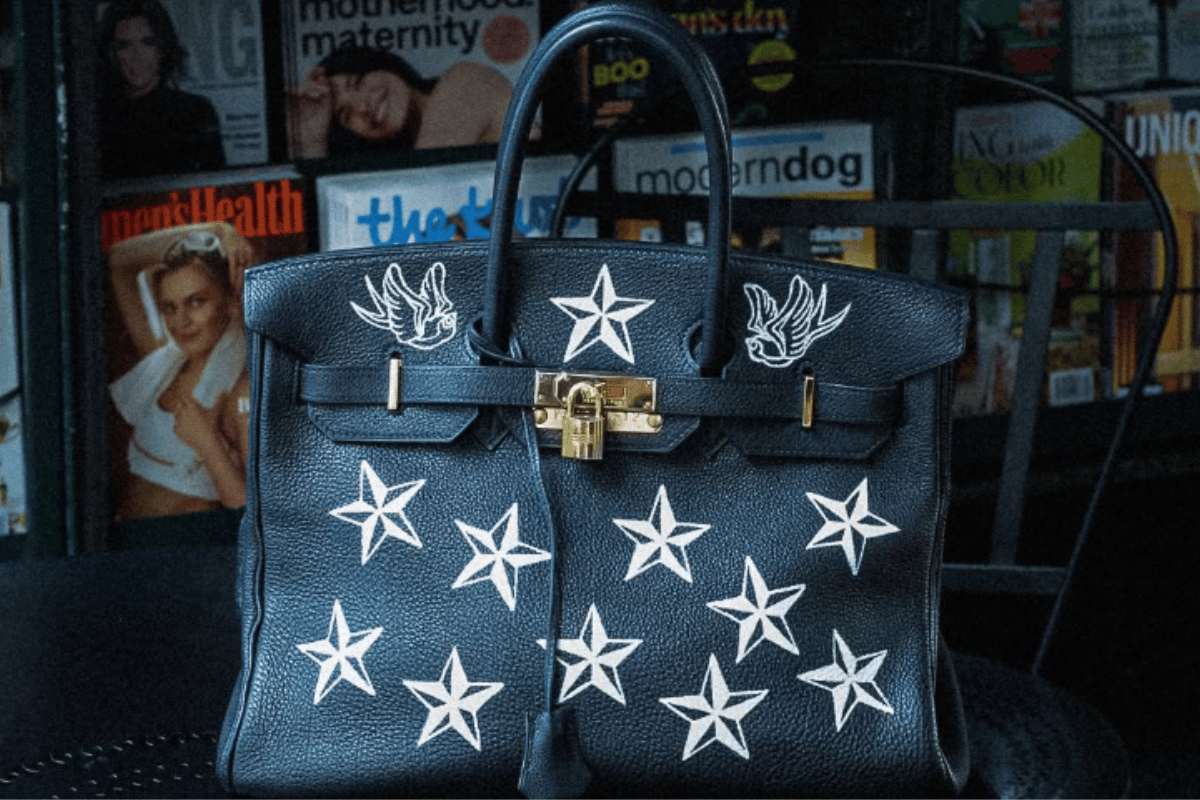
For artist-transformed or one-of-one pieces, evaluation also depends on authorship, provenance, documentation and collector demand. The underlying branded bag provides only part of that context, a distinction central to Philip Karto’s approach.
Treat claims about “designer bags that appreciate in value” with the same care. A platform’s resale-to-retail ratio is not an annual return; its year, sample and definition must be clear.
What costs reduce a handbag’s actual return?
Acquisition, ownership and selling costs can turn an apparent price gain into a loss. The relevant comparison is between the total amount spent and the proceeds retained, rather than between two headline prices.
At purchase, costs may include sales tax, import charges, shipping and an auction buyer’s premium. During ownership, insurance, storage, care, repairs and documentation expenses may also be relevant. Selling can add commission, shipping and insurance.
Christie’s glossary distinguishes the hammer price from the buyer’s premium, which the purchaser pays on top. Seller commission is a separate charge agreed with the consignor. A published price realized is therefore not necessarily the amount the seller receives.
If the acquisition total already includes the buyer’s premium, do not add it again. Likewise, do not deduct a buyer’s premium from seller proceeds as though it were seller commission.
Consider this explicitly hypothetical fixed-price resale:
|
Item |
Illustrative amount |
|
Total acquisition cost |
$10,000 |
|
Resale transaction price |
$12,000 |
|
Assumed seller fee: 20% |
$2,400 |
|
Other ownership and selling costs |
$600 |
|
Net result |
A $1,000 loss |
$12,000 − $2,400 − $600 − $10,000 = $1,000 loss
These are illustrative assumptions, not actual platform terms or a real bag’s performance. The loss is before inflation and any applicable tax on disposal.
Although the transaction price exceeds the acquisition cost, the owner retains less than they spent. For an actual sale, the signed selling agreement and settlement statement provide the relevant fee and payment details.
How do liquidity, inflation and holding time change the picture?
A handbag’s financial outcome depends on when it sells and what the proceeds can buy. Finding a buyer may take time, while inflation can reduce the purchasing power of an apparently higher resale price.
An asking price records what a seller wants, not what someone has paid. At auction, a lot can remain unsold if bidding fails to meet its reserve. Christie’s uses “Pass” for this outcome in its glossary.
Selling also involves more than attracting interest. Condition review, agreement on price, delivery and payment procedures can affect when the owner receives funds. There is no universal selling period that applies to every model or sales channel.
Inflation adds another distinction. A gain in dollars does not necessarily mean a gain in purchasing power. The U.S. Bureau of Labor Statistics’ CPI inflation calculator compares dollar purchasing power over time; it does not measure handbag prices.
Holding time matters because the same net gain earned over one year and over a decade represents different financial performance. Handbags do not ordinarily generate ongoing income while owned.
There is also opportunity cost: money committed to a bag cannot simultaneously be used for another purchase, savings or an alternative investment. Personal enjoyment may justify that commitment, but it should remain separate from the financial calculation.
Why are auction records unreliable guides to ordinary resale outcomes?
Auction records show what particular bidders paid for exceptional objects in specific sales. They do not establish the expected resale price of an ordinary production handbag, even when it shares the same brand or model name.
Jane Birkin’s original 1985 prototype demonstrates why record auction results should not be treated as benchmarks for ordinary Birkins. In July 2025, the bag sold at Sotheby’s Paris for approximately €8.6 million, reported as US$10.1 million, setting a world auction record for a handbag.
Its value reflected exceptional provenance: it was the original bag created for Jane Birkin and personally used by her. That result therefore says far more about a unique historical object than about the expected resale value of a standard production Birkin.
Competitive bidding can amplify the result for a singular object. Record-led coverage also highlights exceptional successful sales while giving less attention to ordinary transactions and unsold lots.
Our guide to the most expensive handbags ever sold at auction examines these landmark results. For ordinary resale comparisons, several recently completed sales of closely comparable bags are more informative than one extraordinary headline.

Buying collectible art: the Philip Karto perspective
Philip Karto’s collectible art brings together the original vintage object and independent artistic authorship. Its Miami atelier transforms authenticated luxury bags through artistic intervention.
Evaluate two layers: the original bag’s brand, model, condition and provenance; and the artist’s authorship and transformation. Document them separately without assuming either establishes the finished work’s resale value. Learn about authentication and provenance.
The Tiberius listing on OneBid reports €32,000 hammer and €40,768 including buyer’s premium for a May 2023 sale of an Hermès Birkin 40 independently customized by Philip Karto, described as new and unworn. It does not disclose the seller’s acquisition cost, holding period or net proceeds, so it cannot establish an investment return.
Explore this approach in the Louis Vuitton by Philip Karto collection.
Philip Karto is independent and is not affiliated with or endorsed by Hermès or Louis Vuitton.


