The Most Expensive Handbags Ever Sold at Auction
Jane Birkin’s original Hermès Birkin is the most expensive handbag ever sold at auction. Sotheby’s sold it in Paris on July 10, 2025, for €8.6 million, reported as approximately US$10.1 million. It was the original prototype made for Jane Birkin, not a normal production bag or a reliable comparable for valuing another Birkin. Sotheby’s original sale announcement confirms the record.
This article covers verified public-auction results. Private-sale claims, retail prices, marketplace asking prices and speculative valuations are excluded.

Auction records checked September 2026.
What is the most expensive handbag ever sold at auction?
The most expensive Birkin bag, and the most expensive handbag at public auction, is Jane Birkin’s original prototype. Its July 2025 Sotheby’s Paris sale established a world record for an object whose significance extends beyond its manufacturer, material or condition.
Created in 1985, the bag has construction details that distinguish it from later production examples. These include a fixed shoulder strap, closed metal rings, gilded brass hardware and Jane Birkin’s stamped initials. Its proportions combine the width and height of a Birkin 35 with the depth of a Birkin 40. Sotheby’s examination of the prototype documents these features.
Its worn surface also belongs to its identity. Here, signs of use connect the object to a documented life. That does not mean wear generally raises handbag prices. It means this bag’s historical importance cannot be separated from the person who carried it.
Which handbags have achieved the highest verified auction results?
Jane Birkin’s own bags lead this selection of verified handbag auction results. Other landmarks include a Faubourg model record, an earlier overall record for a Diamond Himalaya Kelly, and a Chanel runway design that established its own brand record.
Selected Verified Handbag Auction Records
These are selected landmark results, not a definitive ranking adjusted for exchange rates or inflation. Dollar equivalents appear only where the auction house supplied them.
|
Bag |
Auction result |
Auction house/date |
Why it mattered |
|
Jane Birkin’s original Hermès Birkin |
€8.6 million; approximately US$10.1 million |
Sotheby’s, Paris, July 10, 2025 |
World handbag auction record; original prototype |
|
Jane Birkin’s Le Birkin Voyageur, black Box leather Birkin 40 |
US$2.9 million, as reported |
Sotheby’s, Abu Dhabi, December 2025 |
Second-highest Birkin auction result identified by Sotheby’s |
|
Hermès Birkin 20 Faubourg Rouge Sellier |
€635,000 |
Christie’s, Paris online, June 2026 |
Faubourg model record; edition described as fewer than ten examples |
|
Hermès Himalaya Diamond Kelly 28 |
HK$4,000,000; US$515,416 |
Christie’s, Hong Kong, November 26, 2021 |
World handbag auction record at that time |
|
Hermès Diamond Himalaya Birkin 30, 2019 |
€277,200 |
Christie’s, Paris online, April 25, 2023 |
Documented Diamond Himalaya auction sale; exceptional materials and workmanship |
|
Chanel runway silver and black lambskin shopping basket, 2014 |
US$152,400, price realized |
Christie’s, New York online, December 2025 |
World auction record for a Chanel handbag |
|
Hermès So Black Matte Alligator Midnight Faubourg Birkin 20 |
US$137,500, sold price |
Heritage Auctions, October 3, 2024 |
Significant result for the Midnight Faubourg variant |
How to read the prices: A hammer price is the winning bid before buyer’s premium. Christie’s defines “price realized” as hammer plus premium; estimates exclude premium and taxes. Retail and asking prices are different measures. See Christie’s auction glossary.
Sotheby’s original Birkin results release states that achieved prices include buyer’s and overhead premiums. Christie’s reports premium-inclusive results. The cited Voyageur overview and Heritage lot page do not explicitly state whether their reported figures include premium. Those amounts are reproduced as reported, without an inferred hammer price.
Hermès dominates this selection, but the bags represent different kinds of collectibility. The two Jane Birkin-owned examples carry personal provenance. Himalaya diamond bags combine exceptional materials and workmanship. Faubourg editions emphasize architectural design and scarcity. Chanel’s basket demonstrates the importance of runway history beyond Hermès.
Why did Jane Birkin’s original bag sell for $10.1 million?
Jane Birkin’s original bag brought together the design’s first prototype, her personal ownership and documented fashion history. Its US$10.1 million result at Sotheby’s Paris in July 2025 also reflected sustained competition for an object with no equivalent replacement.
The ownership history gives substance to that explanation. Birkin carried the prototype for nearly a decade before donating it to a charity auction benefiting Solidarité Sida in 1994. It appeared at Poulain Le Fur in May 2000 and remained privately owned until the Sotheby’s sale. Sotheby’s provenance account records that sequence.
The initials, unusual fittings and visible wear help explain the object’s appeal as material evidence of her life.
Competition then translated that significance into a price. Sotheby’s reported nine bidders competing for ten minutes, with participation by telephone, online and in the room. A collector in Japan secured the bag. Sotheby’s auction account describes the bidding.
Our reading is that singularity, credible provenance and cultural recognition reinforced one another. Celebrity ownership alone does not establish that combination, and it cannot promise another object a comparable result.
Why do Himalaya and Faubourg bags command exceptional prices?
Himalaya and Faubourg bags attract collectors through different combinations of workmanship, materials, distinctive design and scarcity. Their auction results concern particular examples, with condition, size and documented edition details helping explain why one bag commands more than another.
Himalaya crocodile has a pale tonal gradation that Christie’s attributes to demanding dyeing work. Diamond versions add precious-metal hardware and gem setting. Christie’s guide to diamond handbags records the Diamond Himalaya Birkin 30’s €277,200 sale in April 2023. This is evidence of a completed auction, not a claim that it is the highest production-Birkin result.
Faubourg collectibility centers on a miniature interpretation of the Hermès storefront and the differences between specific editions. Christie’s described the 2024 Rouge Sellier as an edition of fewer than ten examples when reporting its €635,000 result in June 2026. That scarcity statement applies to this edition, not every Faubourg. Christie’s Faubourg record announcement identifies the category precisely.
Heritage’s Midnight catalogue entry offers a useful contrast. It specifies matte alligator, several leathers and black PVD hardware, alongside a condition grade indicating little or no wear. These are concrete identifying details, rather than interchangeable labels such as “rare Birkin.”
The distinction is between a recurring model with exceptional materials and a narrowly defined limited edition. Neither should be confused with Jane Birkin’s historically unique prototype.
Do rare Louis Vuitton bags reach the same auction level?
Selected Louis Vuitton collaborations and limited editions are collectible, but the evidence reviewed here does not establish ordinary Louis Vuitton handbags at the exceptional auction levels achieved by Jane Birkin’s personal Hermès bags.
Sotheby’s guide to limited-edition Louis Vuitton handbags discusses collaborations with Stephen Sprouse, Takashi Murakami and Yayoi Kusama. Their significance includes recognizable artistic authorship and a place within the house’s design history.
That source also discusses the broader secondary market and includes immediate-purchase offerings. Those prices are not completed auction results and are excluded from this table. A collectible collaboration deserves consideration on its own evidence, without borrowing the price significance of an unrelated Hermès record.
What do record prices actually reveal about collectible value?
Record prices show what collectors paid for exceptional objects at particular auctions. They do not establish the resale value of every bag from the same brand, or guarantee that a future buyer will pay more.
Our collector interpretation is that the strongest comparisons begin with the object’s identity: its provenance, material, construction, size, condition and edition. Documentation allows those details to be checked. Cultural importance and credible scarcity explain why an example might stand apart from otherwise similar bags.
The sale itself adds context. Bidder competition, timing, location and international exposure can affect the result. A record captures that encounter between a particular object and a particular group of buyers.
This makes precise language essential. A Faubourg record is not automatically a record for all production Birkins. A former world record remains historically important after it is surpassed. Collectible significance and financial performance should be discussed separately.
From Provenance to Artistic Transformation: The Philip Karto Perspective
For Philip Karto, these auction histories underline the importance of an object’s identity, authorship and documentation. The relevant connection is how a bag acquires meaning through its history and transformation, without treating auction records as predictions for the atelier’s work.
Every Philip Karto piece begins with an authenticated vintage luxury bag. Its original maker, construction and material character remain part of its history. The atelier’s approach to authentication and provenance explains the sourcing and verification that precede intervention.
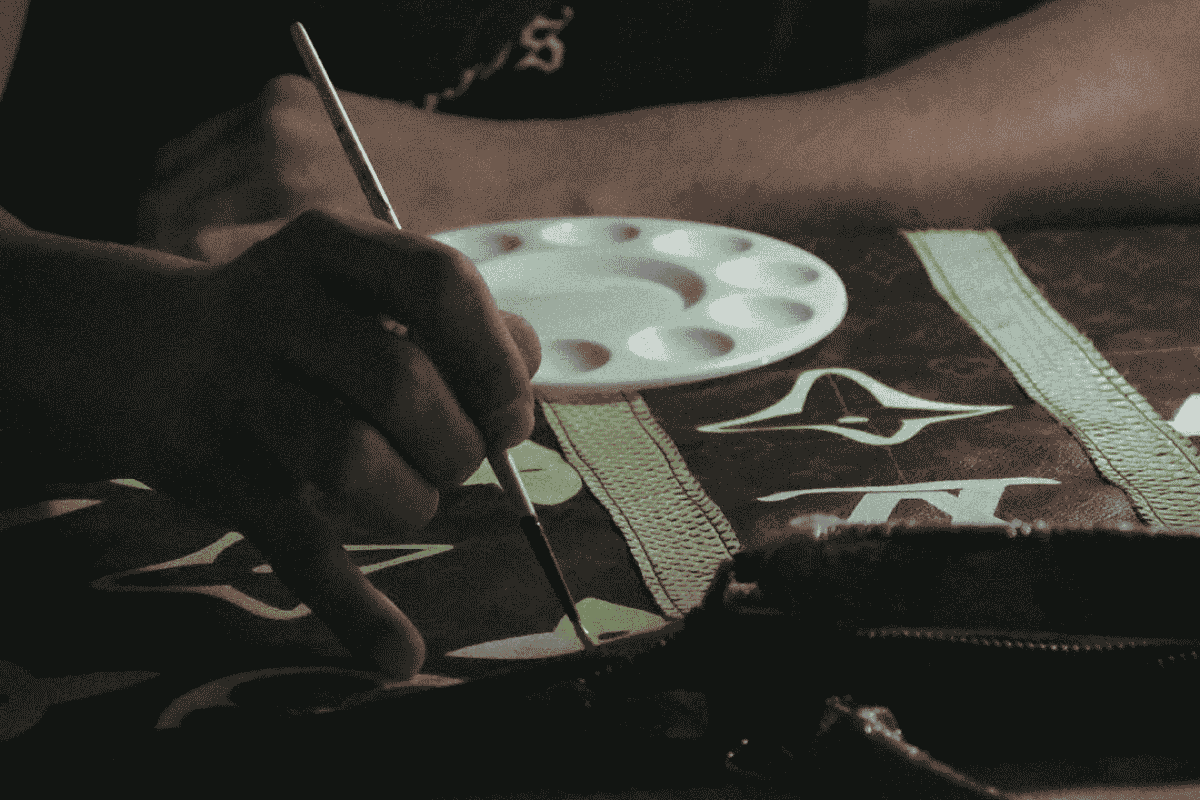
In the Miami atelier, hand painting, embroidery, reconstruction and couture-level stitching create a new artistic expression. The finished object becomes an independently authored Philip Karto work. The vintage foundation and the artist’s intervention are distinct parts of the same object’s story, an approach reflected in the Philip Karto Hermès Birkin collection.
A Philip Karto-Customized Birkin at Auction
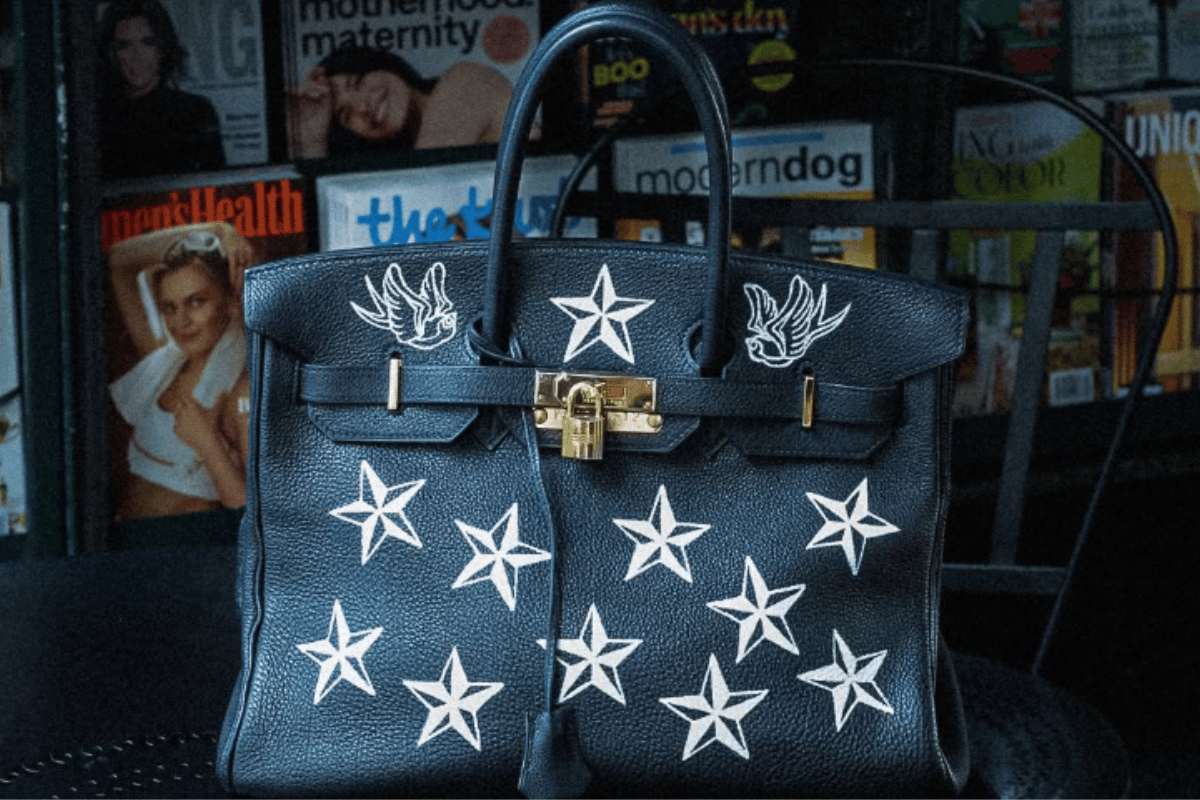
A documented auction result also brings this discussion closer to Philip Karto’s work. The auction-platform record for Tiberius Auctions’ May 2023 sale lists an Hermès Birkin 40 independently customized by Philip Karto at €32,000 hammer, or €40,768 including buyer’s premium. The catalogue describes the calfskin bag as new and unworn. View the Tiberius auction listing on OneBid.
This is a specific example of an artist-transformed handbag finding a buyer at public auction. Its relevance lies in the combination of the original object, artistic intervention and documented sale history. The result does not establish a typical resale price for Philip Karto pieces or guarantee future appreciation.
From our perspective, documentation should make that relationship understandable: what the original object was, how it was transformed and who authored the finished work. It gives collectors a clearer basis for appreciating the piece without implying a future auction outcome.
The Philip Karto atelier approaches this as a continuation of an existing object through artistic authorship. Philip Karto is independent and is not affiliated with or endorsed by Hermès or Louis Vuitton. Its work is presented as collectible art, with no promise of appreciation or a particular resale value.
From Auction History to Collectible Art
The bags that command attention at auction often carry stories of rarity, craftsmanship and cultural significance. At Philip Karto, authenticated vintage luxury bags become the foundation for an independent artistic intervention—creating individually authored works for collectors who see fashion as more than an accessory.
Independent Artistic Works by Philip Karto