Why Are Louis Vuitton Bags So Expensive? 9 Reasons the Price Holds
Louis Vuitton enforces price discipline. No markdowns. No clearance. The business model is built on vertical integration: raw material sourcing through owned retail, meaning the brand controls every point where value could be diluted. Craft and quality control are treated as core cost inputs rather than differentiators added at the end. Prices have risen because manufacturing and transportation costs have increased, and the brand has adjusted accordingly. And luxury demand does not follow normal economic behavior: exclusivity and emotional attachment are part of what is being sold, not incidental to it.
Nine reasons follow. Each one accounts for a different part of that price.
| Reason | In brief |
| 1. Never discounts | Price discipline is structural, not seasonal. No markdowns, no clearance, no exceptions. |
| 2. Market structure | LV controls where its products appear, how they are priced, and how they are experienced. |
| 3. Craftsmanship and QC | Skilled labor, long training pipelines, and rejection rates are real cost inputs. |
| 4. The LVMH model | Vertical integration from raw materials through owned retail protects pricing at every point. |
| 5. Input costs rose | Reuters confirmed: LV raised prices globally in response to manufacturing and transportation cost increases. |
| 6. Luxury economics | Emotional connection and exclusivity change how buyers respond to price. Demand does not behave normally. |
| 7. Canvas pricing | The material is not the price driver. The system around the material is. |
| 8. What you are buying | Durability, status signaling, and value each require a different frame. |
| 9. Where you buy | Each acquisition lane carries a different verification burden. |
Reason 1: Louis Vuitton never discounts
Louis Vuitton states it never discounts its products. Any item advertised at a reduced price online is, in the brand's own words, "invariably fake."
The structural consequences of that policy are direct. It prevents brand dilution: there is no clearance narrative, no end-of-season event, no outlet. It protects the value position of every piece already in circulation. And it makes a discounted price not just a deal to be skeptical of, but a built-in signal of inauthenticity.
Price discipline is not a choice made seasonally. It is a structural commitment.
The most common ways that architecture gets exploited: The Most Common LV Fakes in 2026
Reason 2: The price includes the market structure
In mass retail, price competition and promotions are normal. In luxury, price stability is the value proposition.
Louis Vuitton controls where its products appear, how they are priced, and how they are experienced. That control is not incidental to the brand, it is the brand. Exclusive channels, no discounting, no outlet presence. The result is a market structure designed to prevent the product from ever becoming a commodity.
What does that guarantee look like in practice? When you buy LV at full price, part of what you are paying for is that structure, and the guarantee that the person who bought the same piece last year paid a similar price.
Reason 3: Craftsmanship and quality control are real cost inputs
LV calls it the "Art of Craftsmanship." The framing has an economic basis.
Skilled labor is scarce. Training pipelines are long and expensive. Quality control carries costs that never appear on a price tag (pieces that fail inspection don't ship, but they still cost money to produce). And maintaining consistency at the volume LV operates is structurally more expensive than producing small batches with variable output.
Two bags can look identical in a photograph. The cost difference between them is often in what the photograph cannot show: rejection rates, training investment, and the consistency of the hundredth piece compared to the first.

Reason 4: The LVMH model is built to protect the price
LVMH describes its approach as mastering vertical integration "from the sourcing of the finest raw materials, through manufacturing, to selective distribution," a model the group says guarantees excellence over time.
What that means in practice: LV does not rely on wholesale channels or discount partners to move inventory. Production is controlled. Retail is controlled. Fixed costs are higher as a result, but so is pricing power, because no part of the chain is allowed to discount its way out of excess stock.
Control at the production end and control at the retail end are the same decision, made twice.
Reason 5: Input costs rose. LV adjusted.
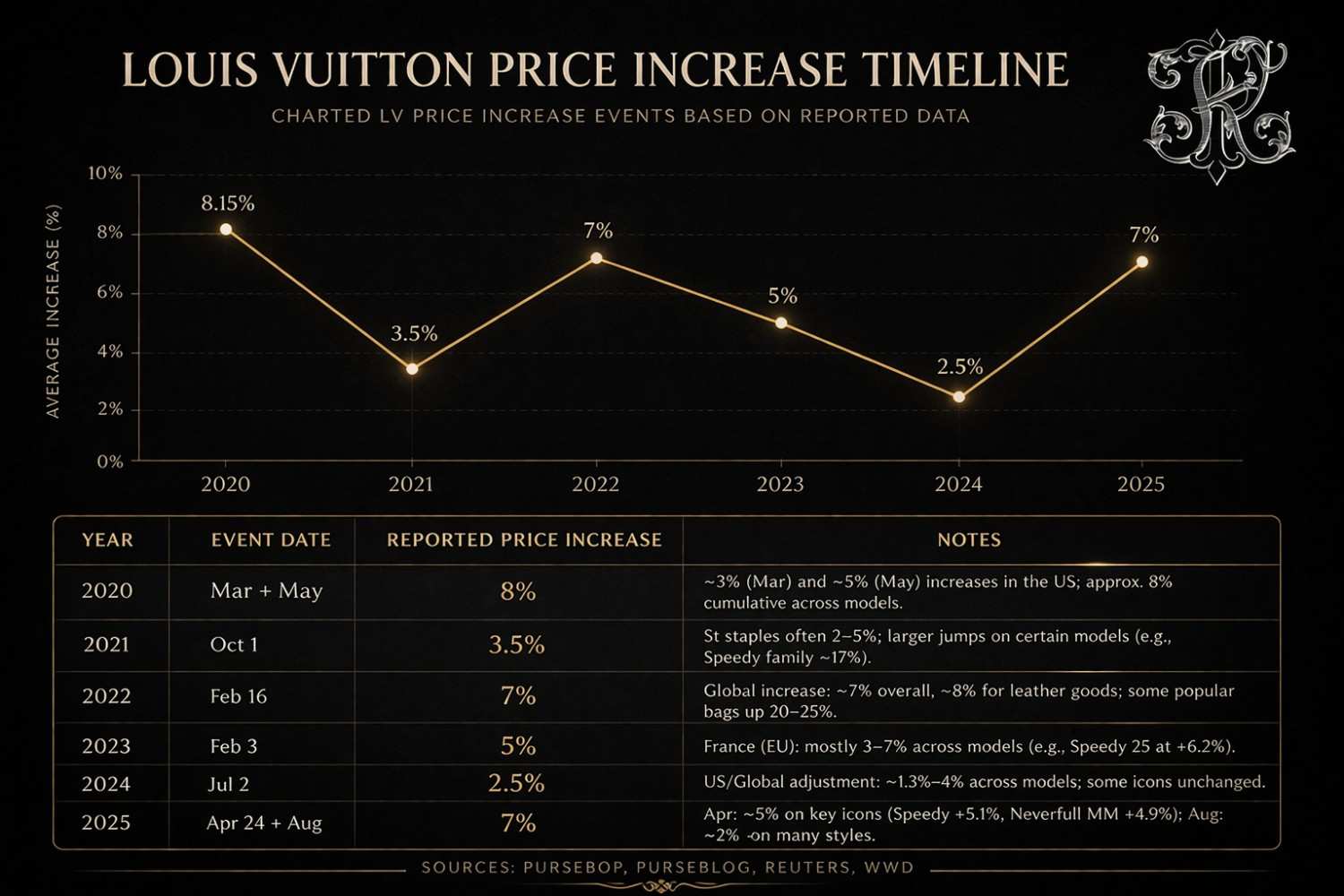
Reuters reported that Louis Vuitton raised prices globally in response to increased manufacturing and transportation costs.
The mechanism is straightforward: inputs rose, and LV adjusted pricing to protect margins. The brand's price increases over recent years are not solely a function of demand or positioning. Part of the answer is simpler: production got more expensive.
Reason 6: Luxury pricing doesn't follow normal economics
In standard markets, raising the price of something reduces demand. Louis Vuitton operates under a different logic entirely.
Economists call it a Veblen good: a product where demand increases as the price rises, because the price itself is part of what is being purchased. The high cost signals exclusivity, and that signal is what certain buyers are paying for. Lower the price, and you don't attract more buyers; you repel the ones the brand is built around.
KPMG's analysis of luxury pricing power identifies how selected brands can raise prices without losing demand, because consumers accept the price itself as part of the exclusivity proposition. Emotional connection to a brand changes how buyers respond to price increases in ways that don't apply to standard goods.
What does that mean for LV specifically? Price is not only a cost-plus calculation. It is also a signal. And Louis Vuitton has spent over a century building the kind of brand position where that signal holds, and where every price increase, counterintuitively, reinforces rather than undermines desirability.
Louis Vuitton Price Increase Timeline

Reason 7: Canvas isn't cheap. The price reflects what canvas alone doesn't explain.
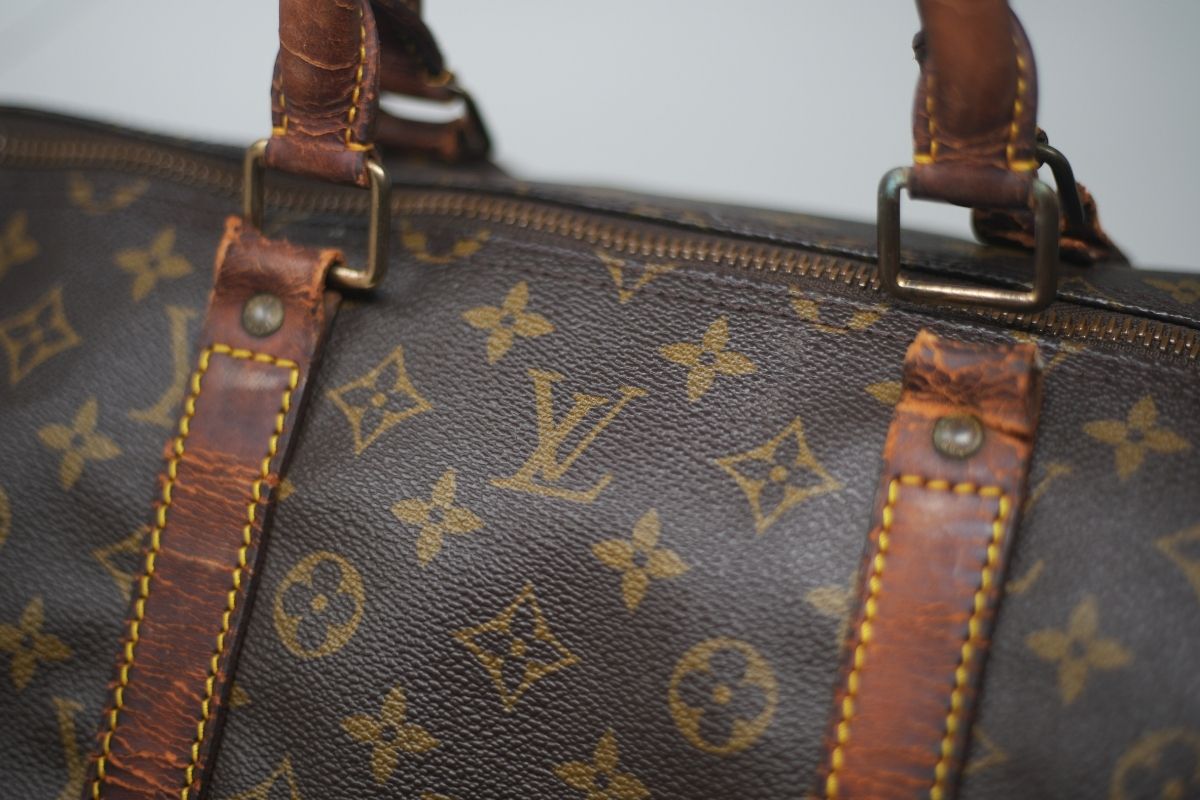
Many iconic LV pieces are built on coated canvas with leather trim. The assumption that canvas means lower cost misses what the price is actually reflecting: pattern IP and production consistency, hardware and finishing standards, quality control, and the same distribution discipline and price structure that applies across every LV product regardless of material.
The material is not the price driver. The system around the material is.
Materials compared in full: Vintage Louis Vuitton Materials: Monogram vs Damier vs Leather
Reason 8: The price makes sense differently depending on what you are buying it for
Not every LV buyer is buying the same thing. The price holds for all of them, but what it reflects depends on the frame.
For everyday durability, the relevant variables are silhouette, material, and condition literacy: how corners wear, how glazing holds, and how patina develops over time. The full inspection framework for vintage pieces: Vintage LV Condition Grades Explained
For status and signaling, price discipline and channel control are themselves part of the product. The consistency of the price across markets and years is not incidental. It is what makes the signal legible.
For value, the calculation shifts. What era is the piece from? What is the condition? Who is selling it, and what proof do they provide? Value in the LV secondary market is created by getting those three questions right, not by finding a lower number.
So which frame applies to you?
Reason 9: Where do you buy, and what can you verify?
Official retail offers the highest certainty and the highest price. There is no authentication question because the chain of custody is unbroken.
Curated vintage requires real verification standards: provenance, condition documentation, and a seller whose proof holds under scrutiny. The price is lower than retail. The burden of due diligence is higher.
That verification burden is exactly what a curated atelier like Philip Karto is built to absorb: sourcing, inspection, and provenance documentation handled before the piece ever reaches a buyer.
Open marketplaces offer the widest price range and the highest variability. Verification becomes the buyer's responsibility entirely.
One factor that changes the verification calculus regardless of lane: the authentication shift from date codes to microchips. What buyers should be asking for in 2026: Date Codes vs Microchips: How LV Authentication Changed
For collectors who want vintage without the verification risk, the question becomes: what proof does the seller provide, and does it hold under scrutiny?
Philip Karto: provenance and authorship
Each vintage Louis Vuitton or Hermes bag entering the Philip Karto atelier is sourced through established secondary-market specialists and undergoes hands-on inspection before any work begins. Structure, hardware, canvas, and original construction are examined in full. Nothing moves forward until the foundation is confirmed. Authentication standards: 100% Authentic
Any original components replaced during reconstruction (hardware, grommets, worn leather elements) are retained and included with the finished creation. What the atelier removes, the collector receives. That is not a policy. It is tangible evidence of vintage origin.

The full process: The Atelier
Each finished piece carries a numbered Philip Karto reference plate, permanently affixed. The PK number is the provenance.
The atelier has been covered by Forbes and documented on Wikipedia. Both provide independent verification of Philip Karto's authorship and practice.
Each piece in the Philip Karto collection is authenticated, documented, and numbered. The PK reference plate is not a finishing detail; it is the provenance record that permanently accompanies the piece.
Browse the full collection: Louis Vuitton or Hermès