The Most Common LV Fakes in 2026 (And How to Avoid “Too-Good-to-Be-True” Listings)
Louis Vuitton is still the most counterfeited luxury brand in authentication data—Entrupy’s 2025 “State of the Fake” report shows LV as #1, accounting for 32.76% of luxury goods submissions.
In 2026, the biggest risk isn’t just “bad replicas.” It’s listing tactics: counterfeit bots/chatbots, return fraud and counterfeit swaps, and live-selling urgency that pushes buyers to skip proof.
This guide breaks down the most common LV fake scenarios you’ll actually encounter, the “too-good-to-be-true” filter to use before you pay, and a proof checklist that reduces risk without turning you into a forensic authenticator.
Read more: How to Stop Peeling Vintage Louis Vuitton
Why LV fakes are harder in 2026 (the new counterfeit playbook)
Older advice assumed you were comparing a bag in person and had time to examine details. In 2026, many scams will be built around speed + frictionless buying.
1) Counterfeit syndicates and “counterfeit bots.”
Entrupy’s report frames counterfeiting as increasingly coordinated, and explicitly notes the “rise of counterfeit bots,” including the stat that 3% of counterfeit purchases are now enabled by chatbots.
Translation for buyers: the scammer’s job is to get you to commit quickly—before you ask for the boring proof.
2) Return fraud and counterfeit swaps are mainstream
Entrupy describes a “return fraud economy” and a “counterfeit swap” playbook where real items get swapped for fakes during returns, and counterfeits recirculate back into resale.
Translation: you can see a listing that looks verified, yet still be dealing with a manipulated supply chain.
3) Live selling makes “vibes” replace verification
Entrupy calls out a “live selling surge,” noting trust often becomes informal and authenticity can become “optional or off-platform,” especially in hype-driven environments.
Translation: live selling doesn’t automatically mean scam—but it does raise the probability that proof steps are skipped.
Read more: Vintage LV Condition Grades Explained: What “Patina, Corner Wear, Piping” Really Mean
The most common LV fakes in 2026 (what they look like + how to avoid them)
Important: I’m going to focus on buyer protection and listing pattern recognition—not micro-tells that teach counterfeiters how to improve.
1) The “superfake listing” (good photos, bad truth)
What it looks like
-
Clean photos, correct-looking packaging, confident seller language
-
“Bought for my wife, never used,” “gift,” “moving sale”
-
Prices just low enough to feel like a “win” but not absurd
How to avoid it
-
Don’t authenticate emotionally. Authenticate procedurally.
-
Treat any single proof (date code, chip, receipt) as supporting, not decisive. Borro (a luxury asset lender) explicitly warns that the presence of a date code, receipt, or authenticity card does not guarantee authenticity.
-
Require a complete photo set (see checklist table below) and use a platform with buyer protection.
2) “Microchip = authentic” confusion scams
What it looks like
-
Seller says: “No date code because it’s microchipped. That proves it’s real.”
-
Screenshot of an NFC scan that shows something exists (but not meaningful LV record data)
How to avoid it
-
Microchips changed what buyers can visually verify. But “chip exists” is not a consumer-verifiable authenticity certificate.
-
If it’s the microchip era, prioritize provenance + return protections + third-party authentication when the price is high.
(If you want to cross-link your cluster: your “Date Codes vs Microchips” post is the perfect deep dive to link here.)
3) “Proof pack” scams (auth cards, random certificates, mismatched paperwork)
What it looks like
-
“Includes authenticity card” or “certificate”
-
Receipt photo that doesn’t match the bag, or a “gift receipt” with minimal detail
How to avoid it
-
Louis Vuitton items are widely documented as not coming with “authenticity cards” in the way many other brands do; even Philip Karto’s own fake-spotting post explicitly says authentic LV products do not come with an authenticity card.
-
Borro also warns receipts can be faked or mismatched and shouldn’t be relied on alone.
Your rule: paperwork can support a story, but it does not authenticate the bag.
4) “Verified label abuse” via return fraud / counterfeit swap loops
What it looks like
-
“Authenticated before” is used as a blanket shield
-
The seller is vague about where it was authenticated and what protections apply
How to avoid it
-
Ask: Authenticated by whom, under what program, and is the protection transferable to the current transaction?
-
Prefer programs that inspect the exact item in the current transaction, not a past claim.
-
Be extra cautious on platforms where returns are frequent and “swap” risk is higher; Entrupy’s counterfeit swap playbook highlights how this happens at scale.
5) Live-selling urgency scams (“someone else is about to buy it”)
What it looks like
-
“Send deposit now,” “DM only,” “Pay off-platform to hold”
-
Pressure to decide in minutes
How to avoid it
-
Live selling can be legitimate, but Entrupy notes authenticity is sometimes optional or off-platform in these environments.
Your rule: no off-platform payment, no rushed decisions, no exceptions.
6) Condition-as-cover (“It’s vintage, so that’s why it looks like that”)
What it looks like
-
Seller hides structural wear behind “vintage character”
-
Photos avoid corners/edges/zipper areas
How to avoid it
-
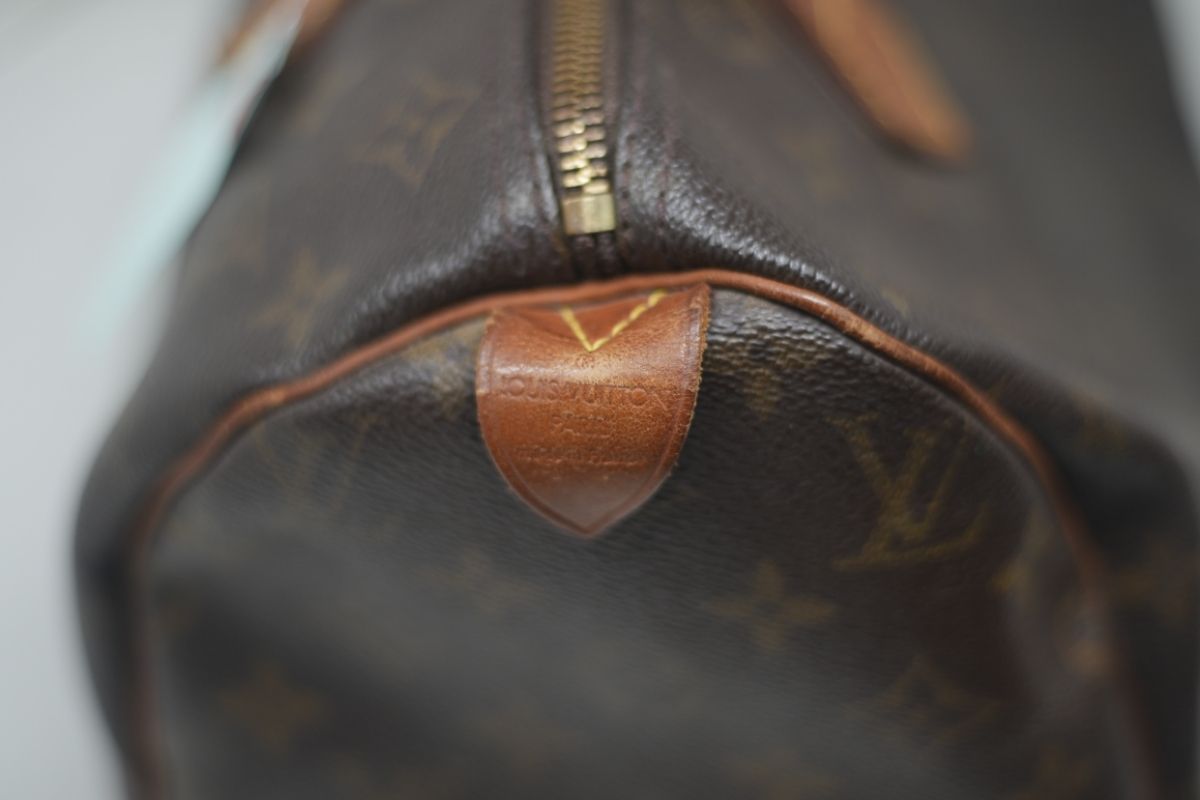
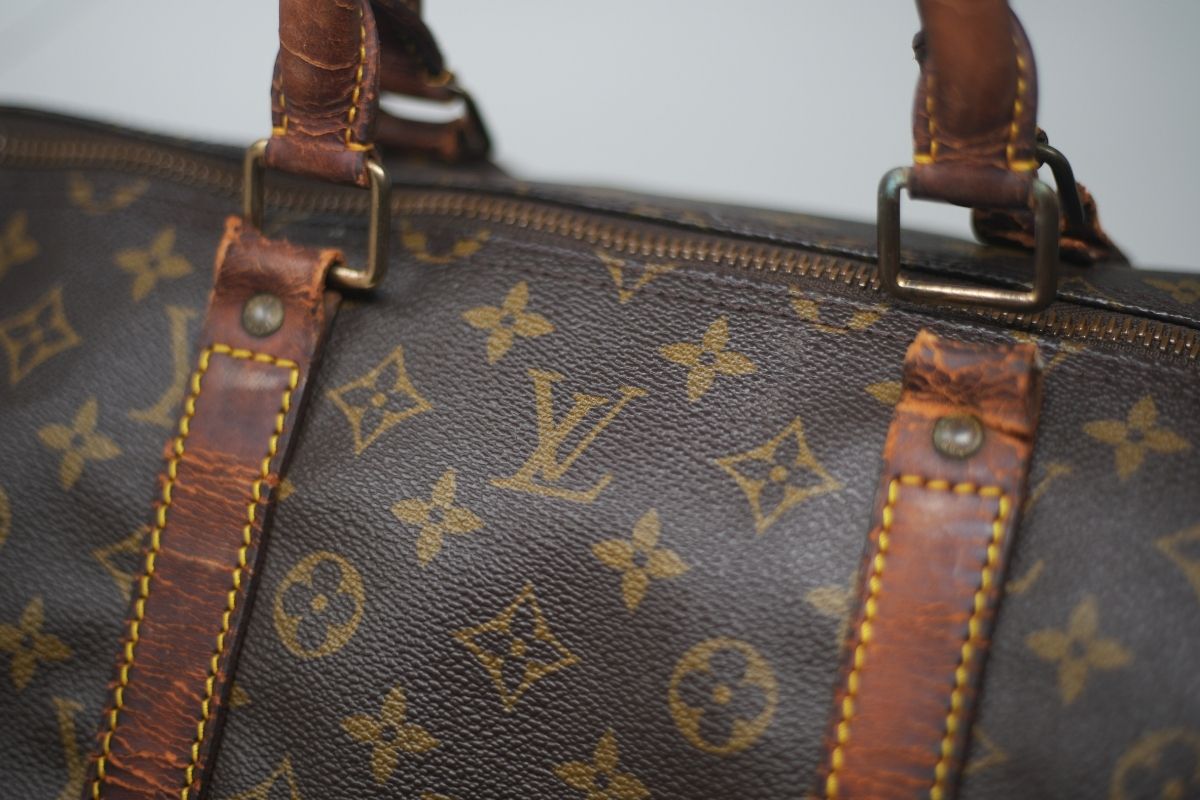
Demand condition photos that show corners, piping/edges, glazing, and interior base.
-
Use your separate “Vintage LV Condition Grades” article as the inspection companion (this creates a powerful internal-link loop).
7) “Too many of the same” seller behavior
What it looks like
-
One seller has multiple “rare” LV bags in multiple colors/sizes, always “new,” always discounted
-
Listings reuse the same background, angles, and phrasing
How to avoid it
-
Treat high-volume + low transparency as a red flag.
-
Ask for a fresh timestamped photo with a specific angle request (e.g., interior stamp + a specific corner). A legitimate seller can comply quickly.
Read more: Vintage Louis Vuitton Materials: Monogram vs Damier vs Leather
The “too-good-to-be-true” listing score
Use this as a fast pre-check before you invest time.
|
Risk signal |
What it looks like |
Score |
What you do next |
|
Price far below comps |
“Need gone today,” “final price,” no flaws listed |
+3 |
Require proof set + only buy with protections |
|
Weak photo set |
Missing corners/edges/interior stamp/date code area |
+3 |
Request specific photos; no photos = walk |
|
Proof theater |
“Auth card,” random COA, receipt-only pitch |
+2 |
Treat as neutral; authenticate the bag, not the paperwork |
|
Urgency pressure |
“Many buyers waiting,” “deposit now,” “DM only” |
+3 |
Slow down 24 hours; refuse off-platform |
|
Off-platform payment |
Wire/crypto/cashapp/“friends & family” |
+5 |
Hard stop |
|
Seller avoids questions |
Defensive, vague, refuses close-ups |
+3 |
Walk |
|
Too many identical listings |
Multiple “rare” LV items, always discounted |
+2 |
Increase scrutiny + verify seller identity |
Interpretation
-
0–3: proceed carefully
-
4–7: proceed only with strong protections + third-party authentication
-
8+: walk away
What to ask for (buyer proof checklist)
This is designed for real shopping conditions (online listings + limited time).
|
Bag type |
Ask for |
Why it matters |
|
Vintage / date-code era |
Clear photo of date code area + interior brand stamp |
Cross-check era consistency (supporting evidence, not proof) |
|
Corners + edges/piping/glazing close-ups |
Reveals wear, repairs, and listing honesty |
|
|
Zipper + hardware close-ups |
Low-quality hardware is still a common failure point in fakes |
|
|
Interior base + pocket corners |
Where damage, lining issues, and odor clues show |
|
|
Seller policy (returns/disputes) |
Your safety net when something feels off |
|
|
Newer / microchip era |
Proof of purchase if available |
Helps establish provenance (still not decisive alone) |
|
Third-party authentication or platform authentication |
Microchips are not a simple consumer “scan to verify” tool |
|
|
Same full condition photo set |
Authentication starts with the physical bag, not a story |
|
|
Clear return/dispute process |
Essential in high-fraud environments |
“Most targeted” LV styles (how to think about it)
Counterfeiters chase volume + recognizability. That’s why the classic silhouettes—totes, Speedy-style handbags, and travel duffles—show up constantly in scam listings.
On Philip Karto’s own Vintage LV collection page, the FAQ explicitly calls out sought-after models like Speedy, Neverfull, and Keepall.
That doesn’t mean every listing of those models is risky—but it does mean your proof standards should be higher because demand is higher.
Buy From a Trusted Curated Source
If you’d rather skip marketplace roulette, buy from a trusted, curated source with clear product presentation and buyer-relevant details.
Buy From a Trusted Curated Source → Authentic Vintage Louis Vuitton Bags (Philip Karto)