Date Codes vs Microchips: How LV Authentication Changed (And What Buyers Should Ask For)
If you’re searching “louis vuitton microchip vs date code,” here’s the buyer-safe truth: date codes were never true serial numbers, and microchips aren’t a consumer “scan to verify” feature. Louis Vuitton began moving away from visible date codes around March 2021, replacing them with embedded microchips, and some items may also be missing a visible “Made in” stamp.
For buyers, that means authentication has shifted from “find the code” to “verify the whole item + provenance.” This guide explains what changed, what each era’s identifiers can and can’t tell you, and the exact proof you should request before paying.

Read more: How to Stop Peeling Vintage Louis Vuitton
The big misconception: date codes were never “serial numbers”
A Louis Vuitton date code was designed to identify production details—not to function like a unique, trackable serial number.
Yoogi’s Closet (a long-running reseller) explains it clearly: LV bags don’t use serial numbers; date codes identify manufacturing location and date, and they do not verify authenticity.
They also emphasize a painful reality: counterfeit items can have date codes that look correct, so a date code is only one parameter in a full authentication.
Read more: Why Buy Vintage Louis Vuitton? 9 Smart Reasons
What date codes are useful for
Date codes are still valuable because they help you sanity-check:
-
whether the format matches the era
-
whether the factory letters align with the “Made in” marking when present
-
whether the construction details make sense for that time period
But it’s a cross-check, not a verdict.
What changed in 2021: from visible codes to embedded microchips
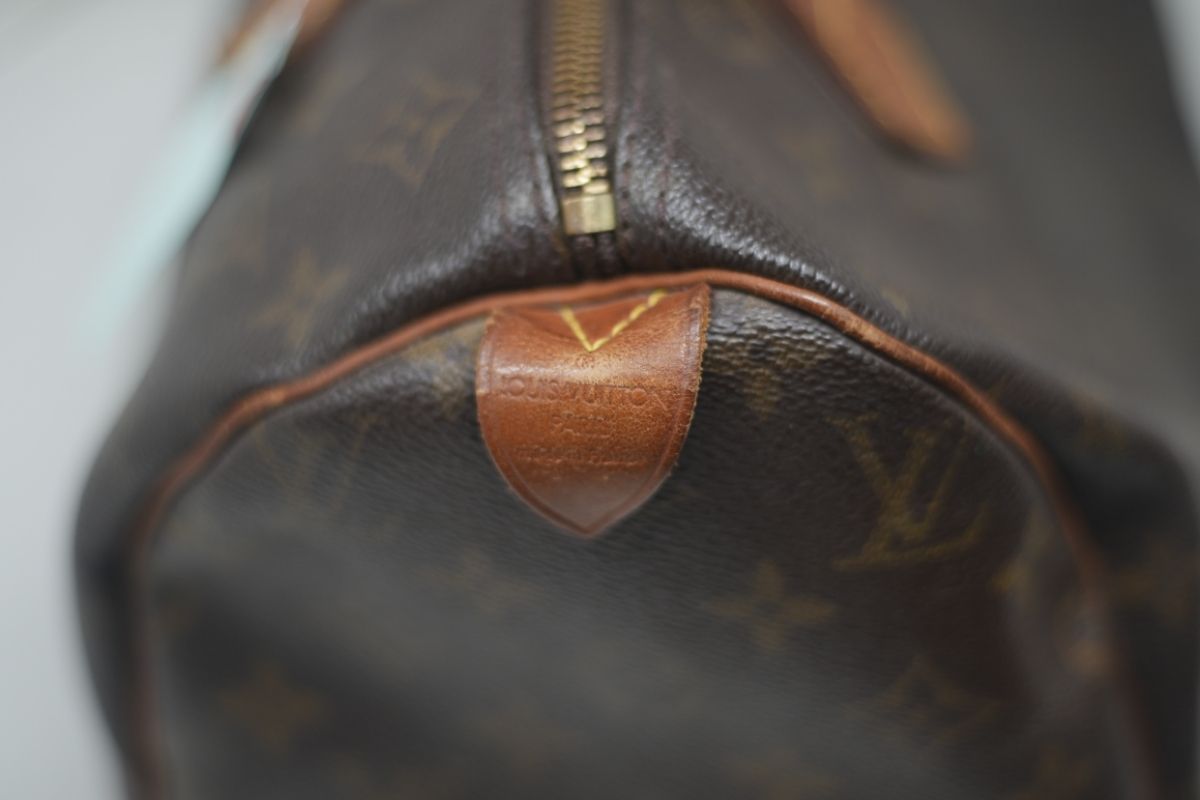
In the date-code era, you could usually locate a stamped code on an interior tab or lining. Then LV began transitioning many items to embedded microchips.
-
Lollipuff notes that as of March 2021, many LV handbags and accessories no longer come with a date code; many may also be missing a “Made in” stamp, and verification is likely kept in-house (not easily accessible to consumers).
-
Xupes similarly states that LV transitioned to microchips as of March 1, 2021, describing microchips as discreet and not visible.
Why this matters for buyers
The “proof” you request changes depending on era:
-
Date code era: you can request clear code photos + craftsmanship details
-
Microchip era: you lean harder on provenance (receipt, seller history), third-party authentication, and return protections—because the chip isn’t a consumer verification tool
Read more: How to Authenticate a Vintage Louis Vuitton Bags
Timeline table: date codes → microchips (quick, practical)
|
Era |
What you’ll see |
What it helps with |
What it does not prove |
|
Pre-1980 / early vintage |
Often no date code |
Dating requires construction/era cues |
Lack of code ≠ fake on true vintage items |
|
Early 1980s |
3–4 digits (year/month logic) |
Rough dating (e.g., “832” = Feb 1983) |
Authenticity by itself |
|
1990–2006 |
2 letters + 4 numbers (month/year coding) |
Dating + factory location cross-check |
Authenticity by itself |
|
2007–early 2021 |
2 letters + 4 numbers (week/year coding) |
More precise dating + factory logic |
Authenticity by itself |
|
March 2021 → now |
No visible date code (microchip embedded; sometimes “Made in” stamp missing) |
Internal LV tracking / security |
“Chip present = real” for consumers |
How date codes work (and why they’re still part of authentication)
Even though date codes don’t authenticate by themselves, they still help frame what “should” be true.
-
Early 1980s: digits reflect year/month; example “832” = Feb 1983
-
1990–2006: letters + numbers; letters = factory location, numbers encode date (month/year). Xupes gives an example: “VI1025” = France, December 2005.
-
2007–2021: letters + numbers; numbers encode week/year (not month/year). Both Xupes and Yoogi’s describe this logic and provide the “SD2057” style example.
When a real bag may have a missing or unreadable date code
If you’ve ever panicked because you “can’t find the code,” there are legitimate reasons:
-
on some older linings (e.g., alcantara), date codes may be hard to read or may disappear, and cleaning can contribute
-
on true vintage (pre-1980), there may be no date code
Buyer move: Missing code doesn’t automatically mean fake—but it increases your need for strong construction evidence and seller protections.
Read more: How to Spot a Fake Vintage Louis Vuitton Bag
What microchips actually mean (and what buyers can’t do)
Microchips are often described as RFID/NFC-based identifiers embedded in the product. The key buyer problem: you typically can’t independently verify authenticity using the chip alone.
-
Official Authentication notes “limited consumer verification”: without access to detailed product information, consumers can’t independently verify authenticity using the chip alone, and counterfeiters could potentially program false information into fake chips.
-
LVBagaholic highlights the same risk in blunt terms: counterfeiters can exploit the fact that buyers can’t easily read the chip and simply claim “it’s microchipped so it’s authentic.”
-
Lollipuff adds that LV likely keeps microchip verification in-house and consumers won’t be able to access verification easily.
The practical takeaway
If a seller’s “proof” is only “it has a microchip,” that’s not proof. It’s a conversation starter.
Read more: Vintage LV Condition Grades Explained: What “Patina, Corner Wear, Piping” Really Mean
What buyers should ask for (the buyer checklist that reduces risk)
This is the heart of commercial investigation intent: you’re not trying to become an authenticator—you’re trying to avoid getting played.
Buyer checklist table (by era)
|
If the bag is… |
Ask for this |
Why it matters |
|
Date code era (most vintage LV) |
Clear photo of the date code + where it’s located |
Lets you verify format logic and whether it’s consistent with the bag’s era |
|
Clear photo of “Made in” stamp/tag (if present) |
Cross-check consistency between claimed origin and code era logic |
|
|
Close-ups: stitching, hardware engravings, zipper pulls, interior seams |
Construction tells are harder to fake at scale; date code alone isn’t enough |
|
|
Full photo set: corners/edges, handles, interior base, pocket corners |
Wear and structure reveal repairs, replacements, or red flags (and protects you) |
|
|
A return policy / dispute option in writing |
If anything feels off after inspection, you need an exit |
|
|
Microchip era (newer LV) |
Proof of purchase (receipt/invoice) if available |
Provenance is stronger than “chip talk” |
|
Seller provenance (where purchased, when, why selling) |
Inconsistent stories are a top fraud signal |
|
|
Third-party authentication report OR platform authentication process |
Chips aren’t consumer-verifiable, so you outsource verification |
|
|
Return policy and a clear “authenticity dispute” process |
Protects you if the claim collapses |
|
|
Photos that prove condition + construction (not just “chip exists”) |
Counterfeiters can exploit chip confusion |
Red flags that matter more than codes or chips
These are the signals that should make you pause immediately:
-
The seller refuses close-ups (especially corners, zipper area, interior tabs/seams).
-
Only stock photos or photos that mysteriously avoid key areas (date code tab, seams, interior pocket edges).
-
The entire listing hangs on one claim: “It has a microchip” or “It has a date code.” Both can be faked, and neither is decisive alone.
-
No return policy and “final sale” pressure tactics.
-
Inconsistent era story: e.g., a supposed 2019 bag with a narrative that implies microchip-only verification (that mismatch is a cue to dig deeper).
Read more: Vintage Louis Vuitton Materials: Monogram vs Damier vs Leather
What smart vintage buyers do now
A smart buyer doesn’t obsess over “code vs chip.” They do three things:
1) They treat identifiers as supporting evidence, not proof
Yoogi explicitly warns that counterfeit items can include date codes; date codes are just one parameter.
Microchips don’t solve that for consumers because consumer verification is limited and misinformation risk exists.
2) They ask for the right evidence set
For vintage: code photo + full construction photo set + seller protections.
For newer microchip items: provenance + authentication process + protections.
3) They buy from sellers who don’t act weird about verification
If a seller acts offended by normal buyer questions, that’s not “luxury”—that’s avoidance.
Philip Karto
If you’d rather avoid the uncertainty that comes with random “chip vs code” listings, Philip Karto’s Authentic Vintage Louis Vuitton Bags collection is built for buyers who want clearer context and a curated selection—while still shopping the vintage era where date codes and construction checks are part of the process.
Shop Authentic Vintage Louis Vuitton Bags