Article: Hermès Birkin Colors: Black, Gold, Étoupe & Statement Shades
Hermès Birkin Colors: Black, Gold, Étoupe & Statement Shades
The right Birkin color depends on the role you want the bag to play. Black gives the silhouette definition; Gold brings caramel warmth; Étoupe sits between grey and brown. A statement shade puts the leather itself in focus. Compare the individual bag rather than relying on a color name alone: leather, lighting and vintage patina all affect its appearance. With a Philip Karto work, consider the original leather and the artwork together.
|
Birkin color |
Visual effect |
Consider it if… |
Check on the individual bag |
|
Black / Noir |
Defined and graphic |
You favor dark accessories or want colorful artwork to stand in clear contrast |
The leather’s surface, hardware and existing patina |
|
Gold |
Warm caramel-brown |
You often wear denim, cream, navy or earth tones |
Its shade in daylight; Gold leather and gold hardware are different things |
|
Étoupe |
Muted grey-brown |
Your wardrobe moves between warm and cool neutrals |
Whether that leather reads more grey or more brown to you |
|
Statement shades |
The leather becomes a focal point |
You enjoy choosing an outfit around a distinct color |
The documented shade and how it looks away from styled photography |
Each Philip Karto Birkin begins with an authenticated vintage Hermès foundation, independently transformed and individually numbered by the atelier. The leather color remains part of the finished composition. The same bright mark can feel sharply defined against Black and warmer against a brown foundation. That relationship is one reason to examine the particular work, not just a color swatch. The atelier explains its approach to authentication and provenance.

Black / Noir: color that gives artwork an edge
Black makes the Birkin’s shape immediately legible. The hardware, grain, stitching and any artistic intervention can each register against a dark surface. Sotheby’s describes Black and Étoupe as distinct Hermès neutrals; Black brings a stronger sense of outline and contrast.
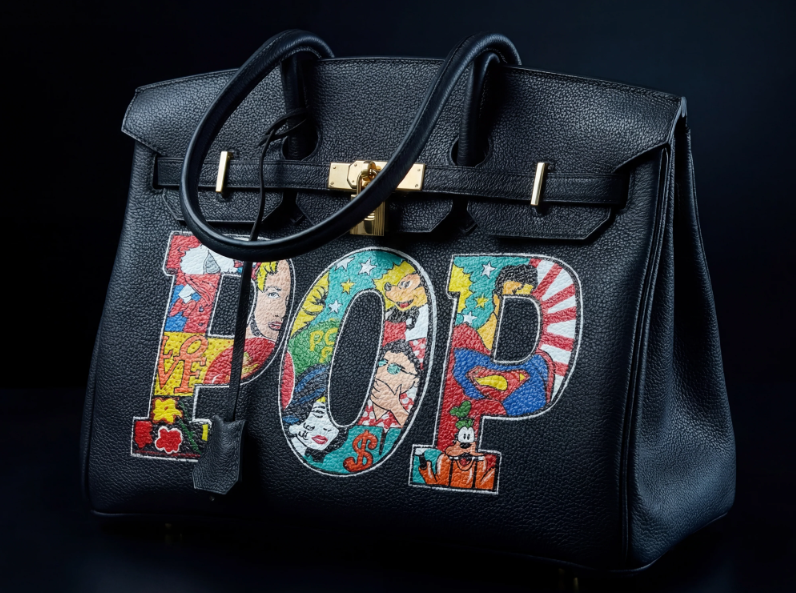
The photographed POP ART Birkin shows why the foundation matters. Its colorful letterforms draw the eye, while the visible black leather gives the composition a firm visual edge. It can work with a dark wardrobe without disappearing into it. When considering a work, compare current photographs of the exact numbered piece: a product gallery does not establish that every execution has the same leather or hardware.

Gold: warmth in the leather, not the hardware
Hermès Gold is a warm caramel-brown leather color. It does not mean a metallic bag, and it does not specify the hardware finish. Sotheby’s explains the color distinction; the separate gold versus palladium hardware guide covers the metal choice.
Gold can add warmth to a wardrobe built around denim, cream, navy and other quiet colors. On a vintage bag, look closely at the actual leather. Lighting, patina and neighboring brown shades can make a photograph appear closer to Gold than the documented foundation really is.
For a Philip Karto example on Gold leather, the atelier would need to identify a specific vintage foundation and supply a current photograph of that work. A warm-brown image by itself cannot confirm the named Hermès shade. Compare any verified example in neutral light, including an unpainted area beside the artwork.
Étoupe: a quieter shift between grey and brown
Étoupe is a grey-brown that offers a softer effect than Black and a cooler one than Gold. Its balance can shift with the leather: Sotheby’s notes that one example may read more grey while another appears warmer. This is a color to judge on the individual bag, particularly if you are choosing it to work with both cool and warm clothing.
Ask to see the same bag in indirect daylight and ordinary indoor light. Look at the handles and corners as well as the main panels, where a vintage piece may show its history differently. The Philip Karto works pictured in this guide do not establish an Étoupe foundation. If Étoupe is the color you want beneath an artwork, it can be discussed as a possible starting point for a commission, subject to sourcing a suitable authenticated vintage Birkin.
Statement shades: distinguish the leather from the art
A statement color can make the foundation itself the focal point. Rouge H offers a deep red with burgundy and brown undertones, as described by Sotheby’s. At a very different intensity, Christie’s documents a soft pink Rose Sakura Birkin in Swift leather. These are examples of original Hermès leather colors, each with its own effect.
An artist-transformed Birkin can carry strong color in another way: through the work applied over its vintage foundation. A pink flower does not make the underlying leather Rose Sakura. Multicolor artwork does not establish a multicolor Hermès leather. When a photograph catches your eye, identify which colors belong to the foundation and which belong to Philip Karto’s intervention.


How leather, light and patina change what you see
A color name is a starting point. Leather texture affects how light meets the surface, photography can alter its apparent warmth, and an individual vintage bag has a history of use. Hermès explains that leather develops a patina and that direct sunlight, intense heat and other elements may change its appearance or color. A current photograph of the actual bag therefore tells you more about its present character than a pristine reference swatch.
A practical color checklist
-
Start with clothes you wear repeatedly. Would you like the bag to continue their palette, add warmth or provide the focal color?
-
See the same bag in two kinds of light. Request indirect daylight and indoor photographs, with any significant editing disclosed.
-
Look beyond the front panel. Examine exposed leather, handles and corners; confirm the original shade, leather type and current condition.
-
For an artwork, identify both layers. Check how the foundation and artistic treatment work together on the exact piece being offered.
How foundation color shapes Philip Karto artwork
The original bag remains visible within the finished work. Leather around a motif gives the composition its background, and its warmth or darkness changes how the added color reads. This can be subtle in a product thumbnail and much clearer in a front view paired with an honest detail photograph.
The pictured POP ART composition places vivid letters against black leather, giving them crisp contrast. The current ROCK’N ROLL gallery presents graphic artwork on a dark foundation; use that image to discuss the art, not as proof of Hermès Gold leather. ROSE takes a floral direction. Its title describes the artwork and does not identify the Hermès leather beneath it.
These examples are ways to judge a composition, not a promise that a named artwork always comes on the pictured foundation. Each vintage bag is individual. Ask the atelier which numbered piece the current photographs show and what original leather that work uses.
Explore the Birkin Art Collection to compare the works and their artistic directions.
Choosing an existing work or discussing a commission
For an existing work, begin with the individual piece. Request current front, back and detail photographs, then confirm its original leather color, size, condition and artistic treatment. A product option called “multicolor” may describe the artwork; it does not, by itself, identify the foundation’s Hermès color.
For a private commission, describe the relationship you want between leather and art. You may have a precise shade in mind, such as Gold or Étoupe, or you may care more about contrast, warmth or the overall composition. The atelier can discuss those priorities while sourcing a suitable authenticated vintage foundation. A particular shade or execution depends on the bag that can actually be found and approved.
Choose the color you still respond to after seeing the individual bag in ordinary light. Then judge whether the finished work has the balance you want to live with. Discuss a Private Commission if you have a specific direction in mind. Philip Karto is an independent artist and is not affiliated with or endorsed by Hermès.