Article: The History of the Louis Vuitton Speedy: From Express to Wearable Art
The History of the Louis Vuitton Speedy: From Express to Wearable Art
The Louis Vuitton Speedy began in the 1930s as the Express, designed by Gaston-Louis Vuitton for an era of faster travel. Reimagined as a Monogram handbag in 1959, it later became closely associated with Audrey Hepburn and the smaller Speedy 25. Its recognizable form now also provides a starting point for independent artistic work, including Philip Karto’s transformations of authenticated vintage Speedy foundations into individually numbered artworks.
|
Period |
What changed |
Why it matters |
|
1930s |
Gaston-Louis Vuitton designed the Express, later renamed the Speedy. |
A travel object took on a form suited to an age increasingly concerned with movement. |
|
1959 |
Louis Vuitton reimagined the Speedy in flexible Monogram canvas as a handbag. |
The familiar pattern became part of a softer bag intended to be carried in daily life. |
|
1960s |
Audrey Hepburn’s request for a smaller version became part of the Speedy 25’s story. |
The silhouette could change scale while remaining recognizable. |
This timeline follows Louis Vuitton’s heritage account and Speedy guide.
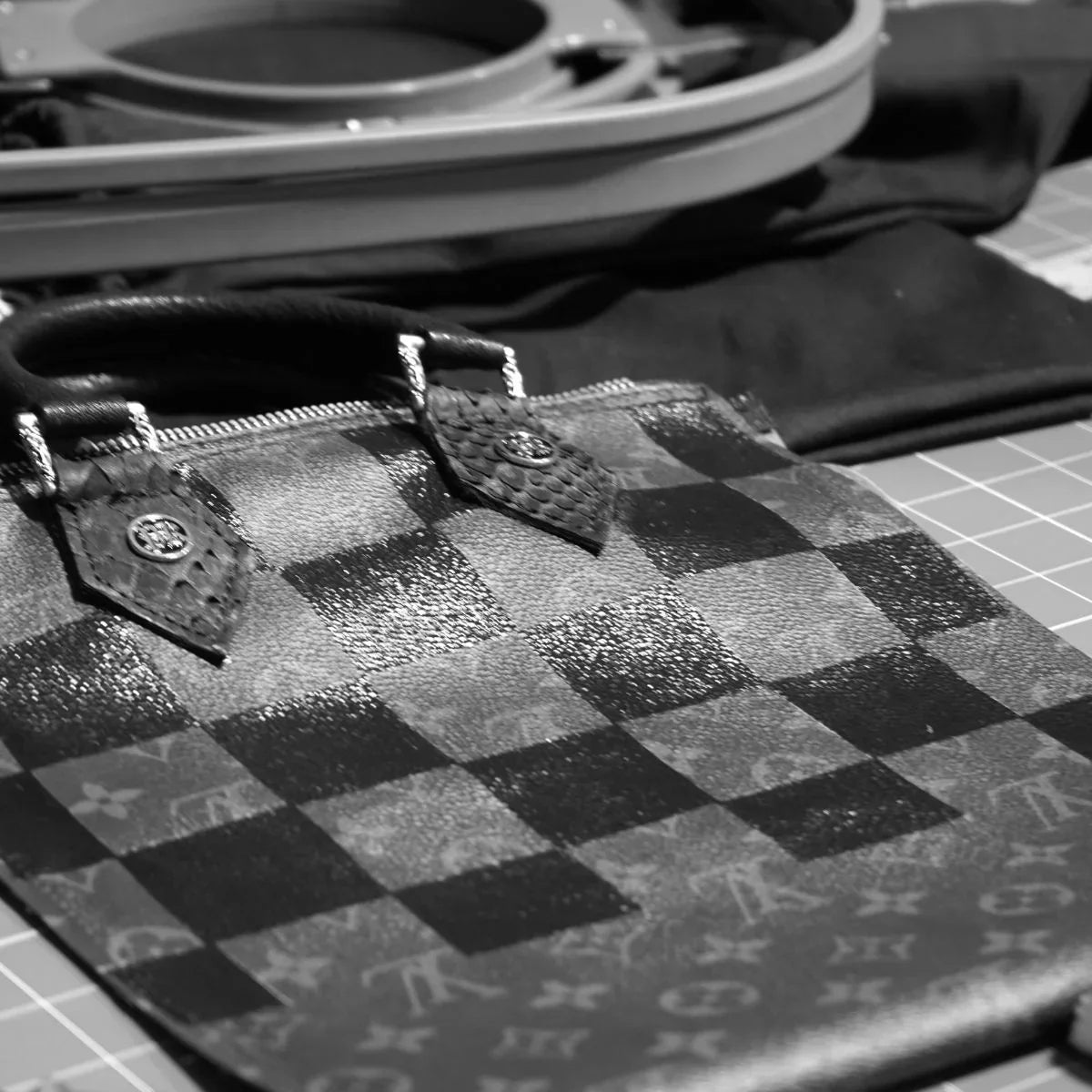
At Philip Karto, that recognizable outline is where our work begins. We select authenticated vintage Speedy foundations and transform them independently into individually numbered artworks. The original form gives the new composition something to respond to: an existing pattern, a curved surface and a familiar place in fashion. Our atelier process explains how we develop that second artistic identity.

From the Express to the Speedy
The history of the Louis Vuitton Speedy starts with movement. In Louis Vuitton’s heritage account, Gaston-Louis Vuitton designed the Express in the 1930s, drawing on the era’s fascination with speed. It began as a carry-on bag before acquiring the name now associated with one of the house’s most recognizable silhouettes.
Express and Speedy both suggest motion. The connection makes the name feel closely tied to the object: a compact travel companion rather than a rigid trunk. Louis Vuitton’s Speedy story also describes a bag that could fold flat, a practical detail that places the original idea firmly within the house’s travel heritage.
Seen in that context, the Speedy’s later life as a city handbag is an evolution of its original purpose. Its form could accompany changing routines without losing the association with travel. That helps explain why the Express origin remains relevant when looking at a vintage example today.
1959: the Monogram handbag reinterpretation
Louis Vuitton records a specific development in 1959: the Speedy was reimagined in Monogram canvas as a handbag. The house’s heritage timeline also explains that a more flexible canvas-coating process, developed in the late 1950s, opened up possibilities for softer leather goods.
The Express origin and the Monogram handbag reinterpretation are separate moments. Each deserves its place in the story.
For a contemporary viewer, the pattern and the silhouette may seem inseparable. Historically, their relationship developed. The familiar brown ground and repeating initials became part of how the rounded bag was recognized, creating a visual language that later designers and artists could address.
Audrey Hepburn and the Speedy 25
Audrey Hepburn’s association brings a personal scale to the history. Louis Vuitton’s own Speedy guide places her request for a smaller version in the 1960s and connects it with the creation of the Speedy 25. It is a small but revealing part of the design’s evolution.
The appeal of this episode is easy to understand: a recognizable design was adapted to one person’s preference. The smaller proportions offered another way to carry the same visual identity. Hepburn’s connection belongs in the story of the bag’s cultural life, alongside its design and materials.
Knowing that chapter in the Speedy 25’s history may make the smaller version more appealing. Choosing a size still comes down to the way you use a bag. Our Speedy and Keepall size guide considers proportions and everyday use.
Why the silhouette leaves room for interpretation
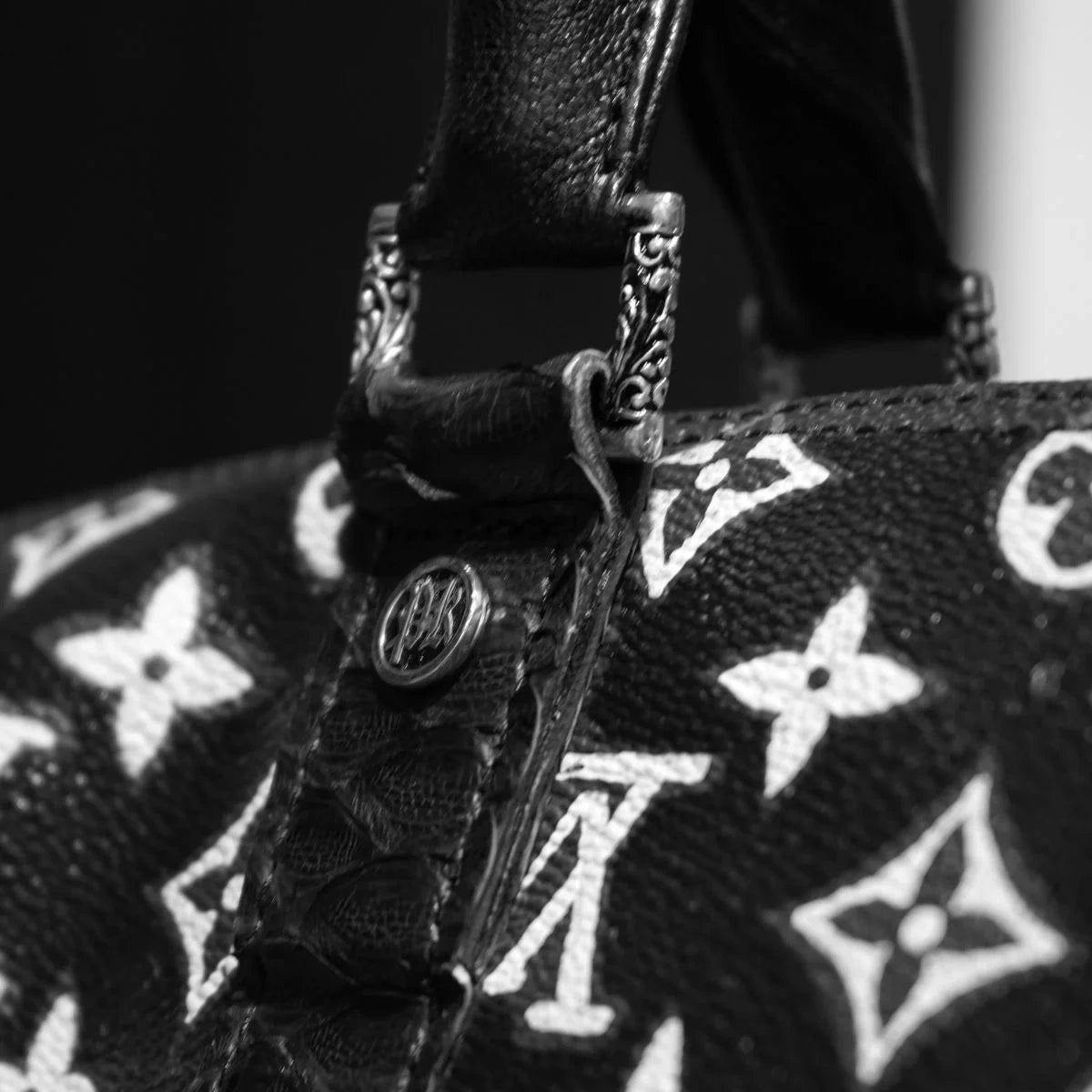
Look first at the outline: the rounded body, the opening across the top and the paired handles. Louis Vuitton identifies the cylindrical form and rolled Toron handles in its own guide. These features give the eye a clear structure to recognize before it begins reading the surface.
That relationship between shape and surface is particularly interesting in an artwork. A composition has to negotiate curves, seams and the interruption of handles. A motif seen on the front changes as the bag turns. The object brings its own proportions to the image; it is never simply a flat painting carried by a strap.
The Monogram creates another visual rhythm. An artist can leave parts of it exposed, work across it or place new figures beside it. To our eye, this is where the Speedy offers such a compelling starting point: its familiar outline anchors the new image.
Official Louis Vuitton collaborations and independent artwork
Official artist collaborations form another chapter in the Speedy’s history. The Louis Vuitton x Takashi Murakami collection, for example, includes Speedy designs and reinterprets the Monogram through the artist’s imagery. These are official Louis Vuitton collaborations, presented within the house’s collections.
Our work begins with an existing vintage bag acquired independently. Louis Vuitton is the original maker of the foundation; Philip Karto authors the later intervention. We are an independent atelier, unaffiliated with and not endorsed by Louis Vuitton.
For a reader moving from fashion history toward an individual artwork, those separate authorships make the object easier to understand. An official collaboration belongs to the original house’s production. A Philip Karto work carries an earlier foundation and a subsequent artistic history under our name.
A closer look at a Philip Karto Speedy

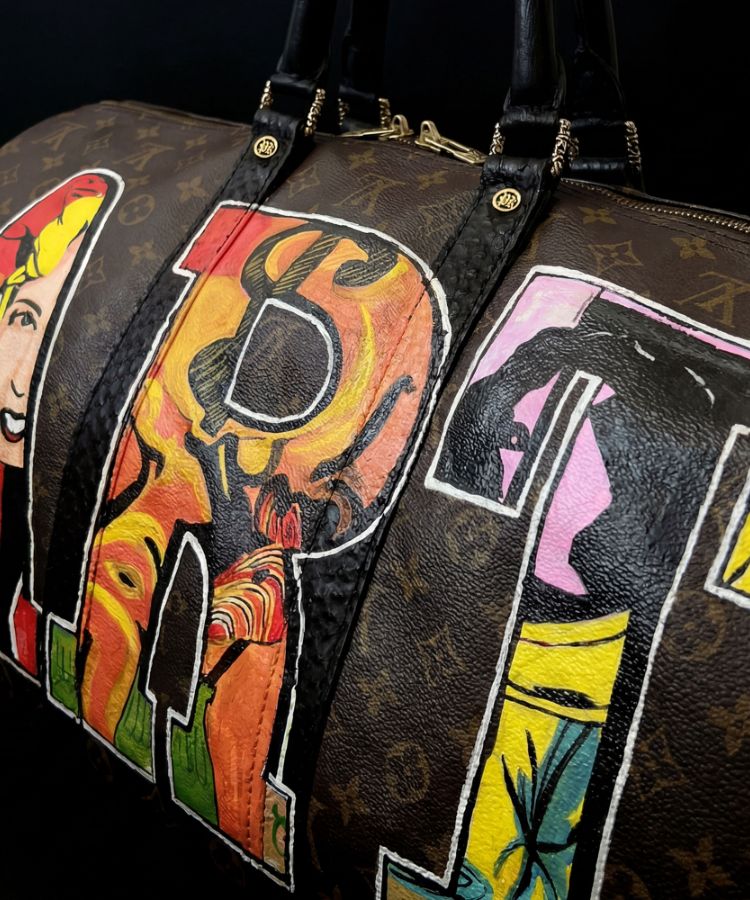
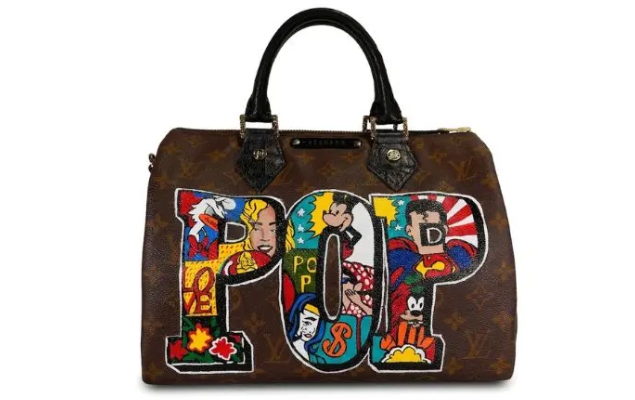
Our POP ART Speedy brings words, figures and icons onto an authenticated vintage foundation through hand painting. It offers a focused way to consider the relationship between the recognizable bag and the new image: the original object supplies the form, while the composition gives the viewer another point of entry.
Begin with a full view, then move closer. Notice where the composition follows the body, where it crosses the original pattern and how it changes around the sides. The pleasure is in that movement between the familiar outline and the details that make the artwork its own.
An individual work’s number belongs to its Philip Karto identity. It records the later artwork rather than supplying a production year for the original bag. That distinction keeps the Speedy’s earlier history and our subsequent authorship clear.

Vintage foundation A Louis Vuitton Monogram travel bag before artistic intervention.

Finished POP ART work Philip Karto’s artwork on a vintage Louis Vuitton foundation.
The Speedy’s model history does not establish the age of this particular foundation. Its production period, condition and later alterations need their own documentation. Our authentication and provenance page explains how we distinguish the original object from the Philip Karto work.
Our guide to hand-painted Louis Vuitton bags explores the artistic intervention in more detail. Here, the focus remains on the Speedy’s journey and the way one existing form can carry a later creative identity.
Discover the Speedy’s next artistic chapter
The Speedy’s history makes looking at a vintage example more rewarding. Its outline carries the memory of travel; its Monogram handbag evolution and Hepburn association add further context. In an independently transformed work, that familiar object becomes the starting point for another artist’s composition.
Each commission is subject to sourcing a suitable authenticated vintage foundation and agreeing the artistic direction with the atelier.